
AI FOR SCIENCE
The virtual cell as the next breakthrough?
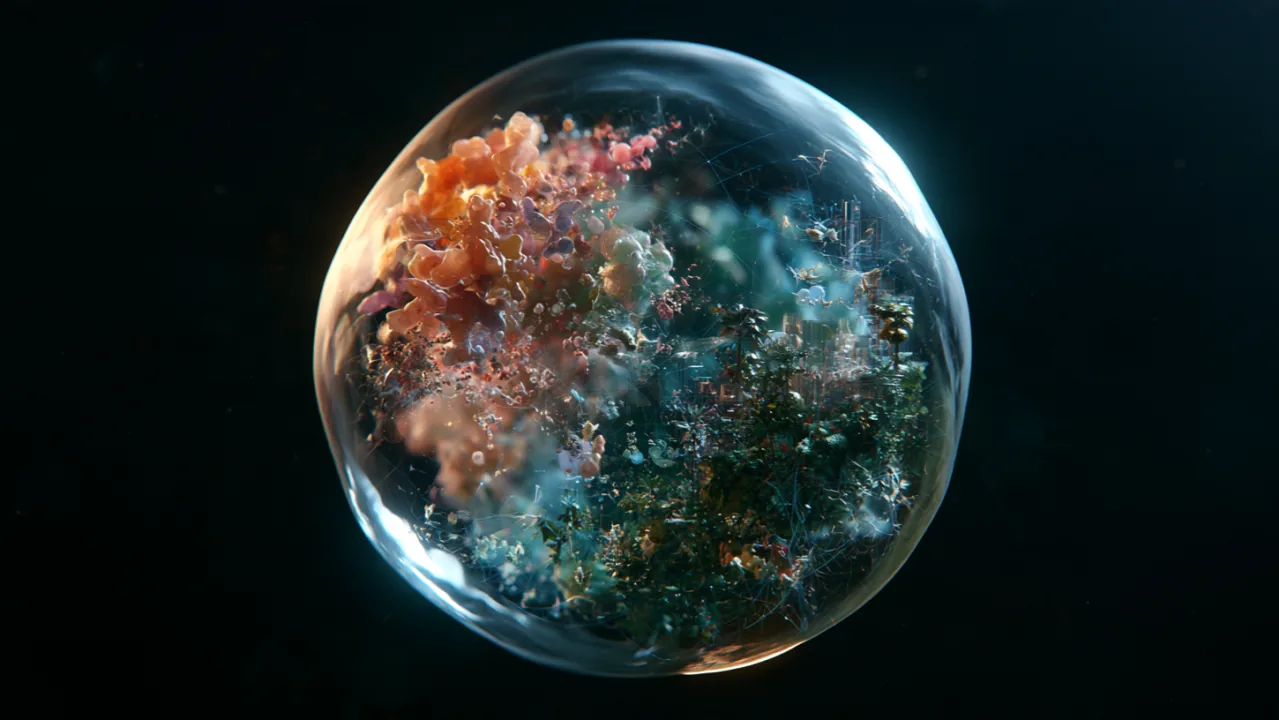
A glass suddenly slips off your table. Before it even hits the floor, you already know what is likely to happen: it will probably shatter, its contents will spill across the carpet and you will soon be reaching for a cloth. This example shows that you possess one of many internal “models” of the world around you – models that connect cause and effect and anticipate the future. Researchers are now trying to teach AI exactly this kind of “world model”. In biology, that ambition is currently being pursued particularly boldly through the example of the cell.
What is a world model?
A world model is something like a mental map or an internal simulation program.
We have learned that an object falls to the ground when we let go of it and that we cannot be in two places at the same time. We automatically connect cause and effect, intuitively understand mechanical processes and can anticipate the consequences of our actions before we act – although, of course, we do not always do so flawlessly.
These world models begin to form in childhood, often through enthusiastic and sometimes risky experimentation. With every action, the models are recalibrated: expectation and actual outcome are compared, and we learn. Robust, adaptable world models are essential for navigating the physical world efficiently.
The “stochastic parrots” learn to walk
Large language models in particular were long regarded as “stochastic parrots” that could “only” reproduce linguistic patterns from data. Concepts such as gravity or causality were known to them only through text, without their apparently “really” understanding them. Yet during training, language models evidently learn more than which token comes next. With a certain degree of fallibility, they also form internal, abstract representations of things and the relationships between them.
Beyond a certain point, it may become useful or necessary for an AI model to learn internal structures that represent parts of the world being described. Anthropic recently found evidence that artificial intelligence can already do this to some extent in its own model: researchers identified millions of so-called “features” in Claude. These are recurring activation patterns associated with particular concepts. Some represent concrete things such as places or people, while others correspond to more abstract patterns such as programming errors or suspected fraud.
From world model to cell model
So how do we get from a world model to a cell model? Quite simply: the cell is the smallest structural and functional unit of life – and at the same time one of the most complex systems humans have ever attempted to understand scientifically. Thousands of simultaneously active genes, enormous numbers of protein molecules and a dense network of biological interactions all operate together at once – an orchestra without a conductor that nevertheless manages to stay in time.
AI development in biology has progressed in overlapping waves. First came sequence-based models for DNA and proteins. Another highly visible breakthrough came with models for predicting biological structures, particularly proteins. Models for single-cell transcriptomics followed. Now comes the attempt to combine all of these layers in a single, dynamic world model of the cell. The economic incentive is considerable: anyone who can conduct experiments “in silico” – on a computer rather than in the laboratory – can save substantial amounts of time and money, although experimental confirmation remains indispensable.
The race to build the digital cell
In mid-August 2026, US startup GenBio AI attracted attention with “AIDO Cell” – short for “AI-Driven Digital Organism” – and what it described as a “preview version of a multiscale, stateful model” of the human cell. GenBio claims that AIDO Cell can simulate genetic and pharmacological interventions across several levels – DNA, RNA, proteins, regulatory networks and cellular behaviour – although the preview initially covers only two cell lines. Founded in 2024, the company aims to position itself as one of the pioneers of the “virtual cell”. A partnership with NVIDIA was added in June 2026.
As exciting as that sounds, GenBio is by no means alone in this endeavour. Virtual-cell models could accelerate drug discovery and toxicology in the future. In medicine, they could create new opportunities for personalised oncology and research into rare diseases. Even so, data quality, biological complexity, scalability and, above all, experimental validation remain explicitly unresolved challenges.
A jumble of terms: virtual cell, digital twin, digital organism?
The idea of modelling cells computationally is not new. What is new is primarily the combination of very large, partly multimodal biological datasets with neural foundation models.
While earlier models mainly described simple organisms in detail, newer data-driven systems attempt to predict the states and responses of human cells across several biological levels.
A brief terminology check is worthwhile because “virtual cell”, “digital cell” and “digital twin” are not used consistently. A virtual cell is comparable to a computer model that simulates or predicts selected cellular states or responses to interventions – such as gene knockouts or pharmaceutical compounds.
A digital twin of a cell or tumour is a more demanding undertaking. It would have to be linked to a specific physical counterpart, integrate relevant individual measurement data, update dynamically as new data become available and provide robust predictions that can support decisions. In medicine, particularly for patient- or tumour-specific applications, this remains predominantly a matter of research and validation.
What companies can learn from this
For companies, a comparable opportunity does not necessarily lie in a universal “world model”, but rather in domain-specific simulation and causal models. These could help assess the likely consequences of clearly defined “interventions” before they are implemented: What happens to costs, delivery capability, quality or compliance if a company changes a process, switches supplier or modifies a pricing rule? Such models do not provide certainty; they provide scenario-based assessments under transparent assumptions.
The crucial distinction is between prediction and intervention. A forecast can estimate how a metric is likely to develop. A causal model should additionally answer how that metric would change if the company deliberately took a particular action. Historical observational data are often insufficient because correlations can be distorted by unobserved factors. Well-documented process changes, suitable comparison groups and – where feasible – randomised tests are therefore particularly valuable.
World models are regarded as a possible building block on the path towards more capable, planning-oriented AI systems. Whether they are necessary or sufficient for a potential “Artificial General Intelligence” remains an open question. For companies, the immediate value is more concrete: moving beyond isolated predictions towards better-tested scenarios and decisions within clearly defined business processes. These are ideas that are well worth developing further – including in the comments.